
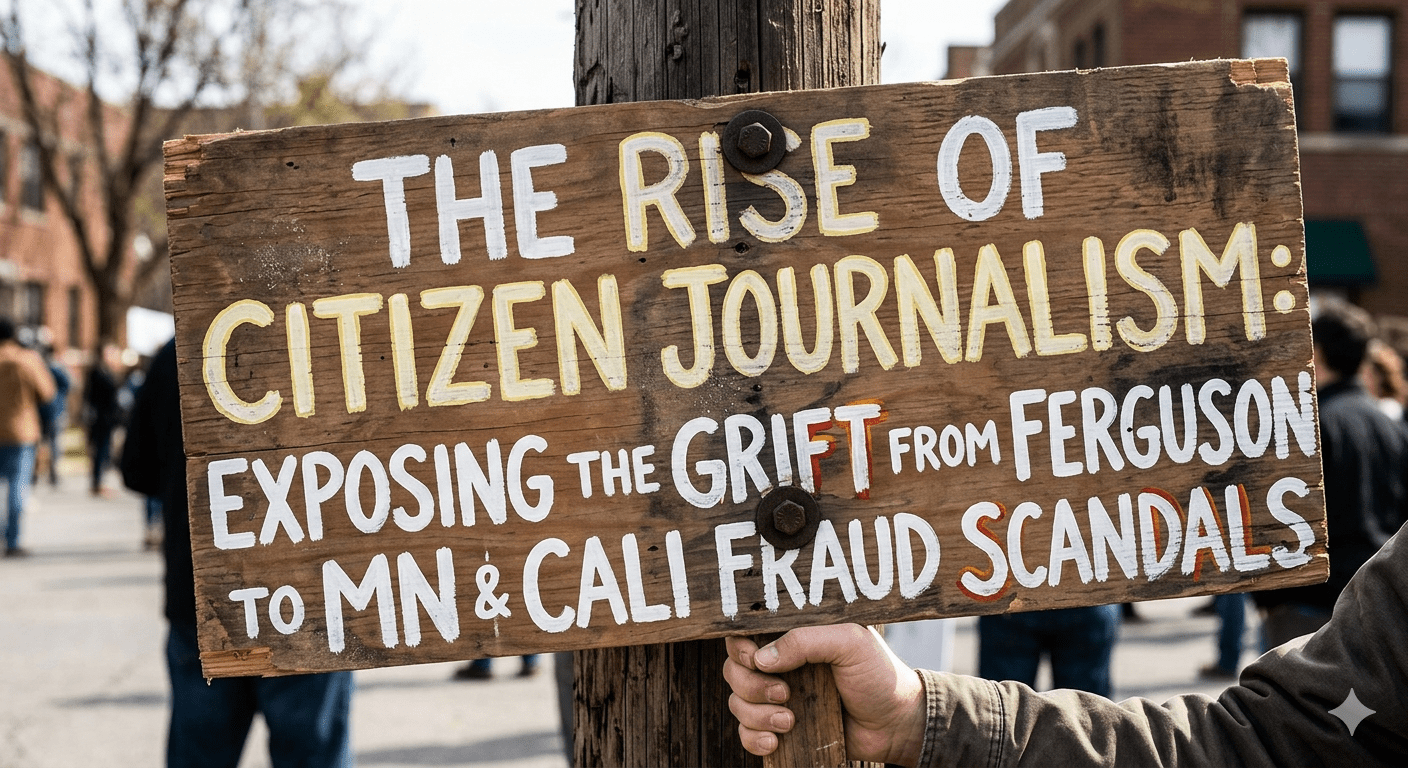
In an era where legacy media often amplifies official narratives while ignoring uncomfortable truths, citizen journalism has emerged as a powerful force for accountability. Ordinary individuals armed with smartphones, social media, and independent platforms have bypassed gatekeepers to reveal systemic exploitation.
Two pivotal moments illustrate this shift: the groundbreaking work of Nyota Uhura and the late Darren Seals in Ferguson, Missouri, who shone a light on how Black Lives Matter (BLM), NGOs, white liberals, the Democratic Party, members of the clergy, paid protesters, and professional activists profited from the deaths of Black people killed by police. Their efforts laid the foundation for today’s citizen journalists, exemplified by Nick Shirley, whose exposés on government fraud in Minnesota and California have triggered political earthquakes, including Tim Walz dropping his reelection bid as governor.
Ferguson: Black Death as a Business
The 2014 killing of Michael Brown in Ferguson sparked national protests and the rise of the BLM movement. But while the world focused on the hashtag and street demonstrations, local voices like Darren Seals—a Ferguson native, GM assembly line worker, and co-founder of Hands Up United—refused to stay silent about what they saw as exploitation. en.wikipedia.org +1
Seals, a working-class activist who had protested police violence long before Brown’s death, watched as national BLM organizers, out-of-town elites, and NGOs descended on his community. In raw social media posts and videos, he called it out plainly: “BLACK DEATH IS A BUSINESS.” Millions poured into organizations in Michael Brown’s name, yet little reached Ferguson’s streets or its youth. “I’ve been calling out this shit for months,” Seals wrote. “People see this as an opportunity to not only build a name but make bank at the expense of the lives of people like me.” thecorrespondent.com
Nyota Uhura, a pioneering Black independent journalist and digital media trailblazer (known online as @bgyrl4life), stood shoulder-to-shoulder with Seals. Together, they exposed how BLM had morphed from a grassroots slogan into a professionalized machine. Uhura has stated unequivocally: “Darren and I exposed BLM.” She documented how the movement was hijacked—not by police or conservatives—but by professional activists, NGOs, white liberals funding the operation, Democratic Party insiders, clergy members involved in the protest ecosystem, and paid agitators who turned tragedy into a revenue stream. x.com +1
Their reporting highlighted the “protest industrial complex”: grants, donations, and speaking fees flowing to national figures while Ferguson’s local Black community saw no tangible change. Seals clashed publicly with prominent BLM-aligned activists like DeRay Mckesson, accusing them of parachuting in for clout and cash. Uhura faced ostracism and vilification for amplifying these truths through indie Black media, while Seals paid the ultimate price. On September 6, 2016, he was found shot to death in a burning car in Riverview, Missouri. His murder remains unsolved, fueling suspicions amid the very movement he criticized. spokesman-recorder.com
Seals and Uhura’s citizen journalism—raw, unfiltered posts, videos, and on-the-ground reporting—challenged the sanitized narrative pushed by mainstream outlets. They revealed how Black pain was monetized: BLM’s Global Network Foundation later reported raising $90 million in 2020 alone, with allegations of lavish spending (including a $6 million mansion purchase) while local communities were left behind. huffpost.com
This wasn’t conspiracy; it was documented exploitation of police-involved deaths for financial gain and political agendas.
The Legacy: Citizen Journalism Evolves
What Seals and Uhura pioneered in the pre-viral-video era—using social media to speak truth to power—became the blueprint for a new wave of independent reporting. No longer reliant on corporate media approval, citizens could film, edit, and distribute evidence directly to the public. Their work marked the beginning of a movement that prioritizes facts over feelings, accountability over activism-for-hire.Fast-forward to 2025-2026, and independent YouTuber Nick Shirley embodies this evolution. A self-described citizen journalist with a massive following, Shirley turned his camera on systemic fraud in Democrat-led states, exposing how taxpayer dollars were allegedly siphoned through welfare programs—often involving the very communities once invoked in BLM rhetoric.In December 2025, Shirley released a 42-minute documentary investigating Minnesota’s childcare subsidy program. He visited Somali-run daycare centers receiving millions in state and federal funds despite safety violations, empty facilities, and questionable operations. The video exploded, racking up millions of views. It spotlighted alleged billions in fraud tied to pandemic-era programs, with direct implications for Governor Tim Walz’s administration. Shirley’s reporting didn’t just go viral—it sparked federal investigations, congressional hearings, and intense scrutiny. By early 2026, Walz announced he would not seek reelection, with Shirley’s work widely credited as a catalyst. Walz’s team dismissed Shirley as a “conspiracy theorist,” but the fallout was undeniable. yahoo.com +2
Undeterred, Shirley turned to California, releasing footage exposing what he described as an even larger fraud crisis—over $170 million uncovered in hospice care, daycare, and healthcare schemes. He confronted luxury lifestyles funded by public money while facilities appeared abandoned or non-operational. Governor Gavin Newsom’s office responded by mocking Shirley online with a doctored image, but Shirley fired back, accusing Newsom of prioritizing image over accountability. “You are the biggest fraud,” Shirley retorted as California charged individuals in related cases. Newsom’s ire only amplified the story, proving citizen journalism’s power to force even entrenched politicians into damage control. youtube.com +1
Why Citizen Journalism Matters
The arc from Ferguson to these modern exposés is clear: citizen journalists like Nyota Uhura, Darren Seals, and Nick Shirley have democratized truth-seeking. They bypass biased gatekeepers, document realities on the ground, and hold the powerful accountable—whether it’s a movement profiting off Black death or politicians enabling fraud under the guise of social services.Their impact is measurable: political careers altered, investigations launched, public awareness raised. In Black communities especially, this journalism reveals how exploitation isn’t just external but internal—professional activists and NGOs turning tragedy into personal empires. As Uhura continues her work honoring Seals’ legacy, and Shirley racks up views while testifying before Congress, one truth endures: the camera and the keyboard are mightier than any press release.Citizen journalism isn’t perfect. It faces smears, threats, and skepticism. But as Seals and Uhura showed a decade ago—and Shirley proves today—it forces America to confront uncomfortable realities. In the battle for transparency, the citizens are winning. Black death is no longer just a business—it’s a story being told by those who refuse to let it stay buried.
