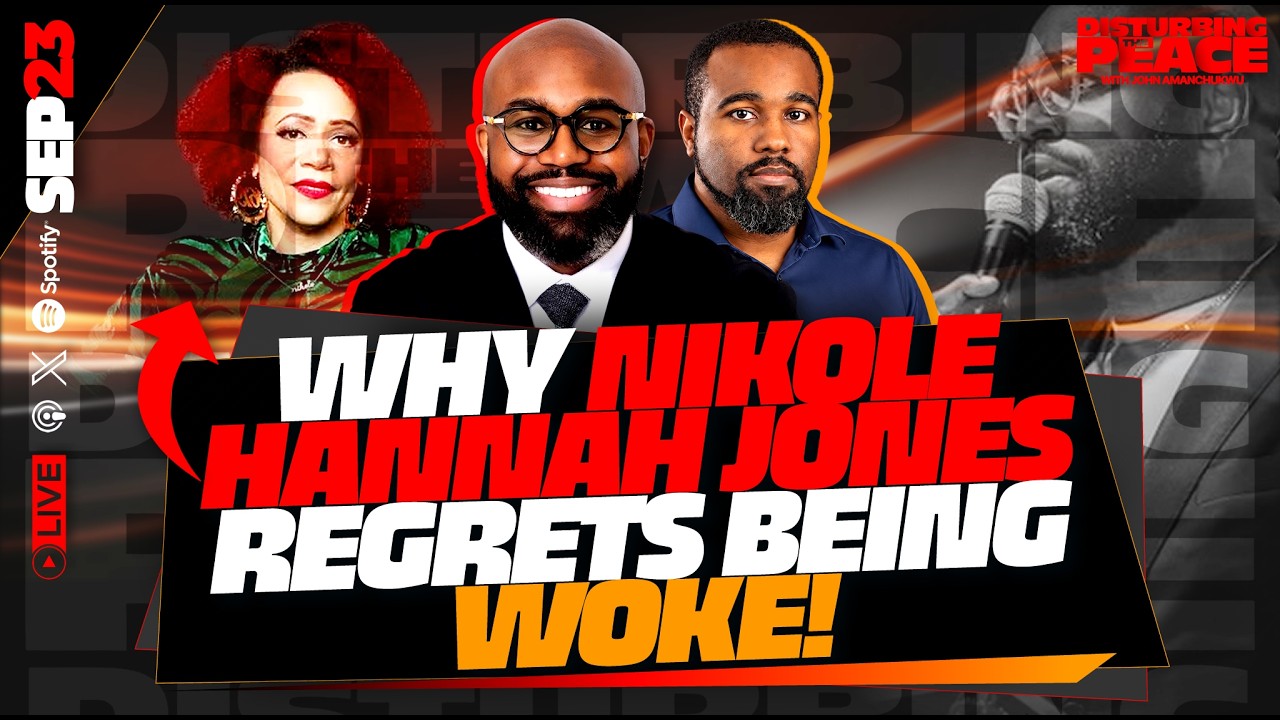
Nikole Hannah-Jones — creator of the 1619 Project — wrote in the New York Times on September 20 about the school she chose for her daughter.
Her daughter, now 16, told her she made the wrong choice.
Adam B. Coleman joins John Amanchukwu to work through it. Coleman is an author, founder of Wrong Speak Publishing, and director of the forthcoming documentary The Illegal Highways.
His first response is to credit her for admitting it. He says he isn’t sure he would have, publicly. But then he gets to the problem.
The decision was made for an idea, not for a child.
Coleman’s argument is that parenting decisions should improve your child’s circumstances — full stop. Anyone with options has a point of privilege, and she had options. She could have sent her daughter anywhere. She chose a school to make a statement about integration, and the statement cost her daughter years she can’t get back.
His line about what parenting actually is: there’s no greater honor and privilege — and sometimes your decisions are only beneficial for your child and not for you personally. Your child is not a prop.
John’s observation: she did reverse school choice. Everyone else is trying to get their kids out. She tried to put hers in. Which, he argues, makes her a billboard for charter schools and education savings accounts whether she likes it or not.
And then the exchange that carries the episode.
Coleman explains in-group and out-group thinking — why leading Black voices won’t criticize her, and why the same people extend no grace at all to someone outside the group. His conclusion, which John makes him repeat: bad ideas exist in the brains of people of all colors. If someone happens to look like you, that doesn’t make what they’re saying right. Mimic people who make good decisions.
He’s also direct about what silence costs. Refusing to correct someone because they look like you isn’t love — it’s abandonment. Real love says I think you’re making a mistake, and I’m saying it because I care.
Then the documentary, and it’s the harder half.
Coleman didn’t set out to cover trucking. A crash changed that — and when he started talking to drivers, it was worse than he expected in every conversation.
He walks through the licensing failures, chameleon carriers that shut one company down and open the next, the broker layer that takes a cut and drives the price down until only the shadiest operator will take the load, and a recent unanimous Supreme Court ruling on brokerage negligence.
And the human part. Four families. Four deaths. He describes sitting with a grandfather who has to tell his grandson that his mother is gone.
His approach was to tell their stories rather than make a political film — but he’s honest that some of it is political, and he’s equally honest in the other direction: the drivers themselves are being used. Twenty hours behind the wheel against a legal limit of eleven, in old trucks, paid almost nothing, set up to fail by the companies employing them.
Plus the requirement that surprised both of them: English proficiency has been required to hold a commercial driver’s license since the 1930s. What changed wasn’t the rule. It was whether anyone enforced it.