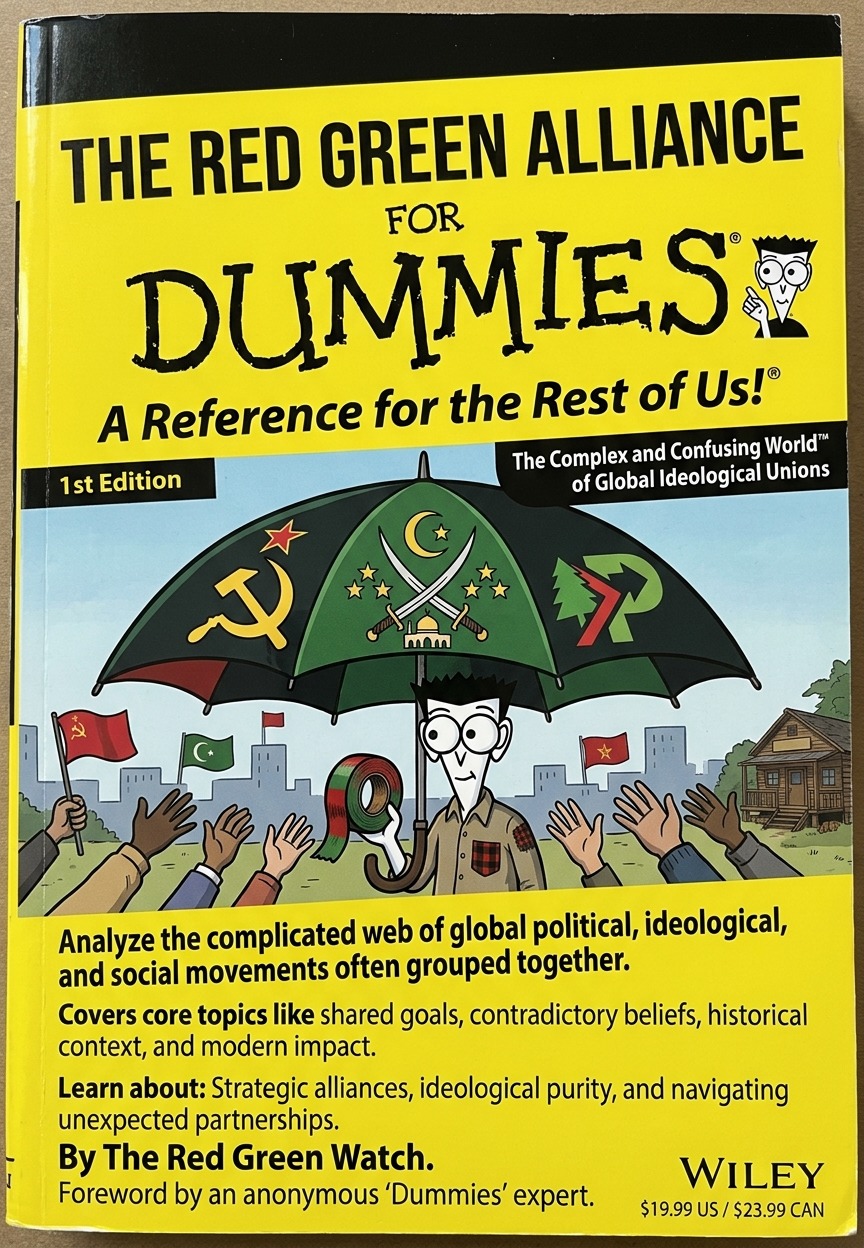
The “Red-Green Alliance” For Dummies
Imagine two groups that disagree on almost everything about how people should live—but they team up because they share some of the same big enemies. That’s the basic idea behind what’s called the “red-green alliance.”
“Red” stands for the far left: communists, socialists, Marxists, and progressive activists who want major changes to capitalism, Western institutions, and traditional power structures. In the U.S., a key example is the Democratic Socialists of America (DSA), a group that has grown in influence within parts of the Democratic Party. “Green” refers to Islamist movements—groups that want society organized around their interpretation of Islamic law (sharia) and often view the West as an opponent. The Muslim Brotherhood, founded in Egypt in 1928, is the main historical example of this kind of political Islamism. Its ideas have influenced various organizations and activists in the West.
The term “red-green alliance” describes times when these two sides cooperate politically, even though their end goals clash. Socialists generally want a secular, equal society focused on class and identity. Islamists typically want religious rules that can conflict with progressive views on gender, sexuality, and free speech. They often set those differences aside to focus on shared targets: opposition to U.S. foreign policy, capitalism, Western culture, and especially strong support for Israel (or opposition to it).
A Quick Look at the History
This kind of partnership isn’t brand new. A famous example is Iran in 1979. Leftist groups helped Islamists overthrow the Shah (the country’s ruler). Once the Islamists took power under Ayatollah Khomeini, they turned on many of their former leftist allies—arresting, exiling, or worse. Critics of today’s alliances often point to this as a warning: temporary partnerships can end badly for one side.
In the West, similar patterns have appeared. After the October 7, 2023, Hamas attacks on Israel, large protests brought together progressive activists, DSA members, and pro-Palestinian groups (some with ties or sympathy toward Islamist networks). Campus encampments, street marches, and political organizing often mixed socialist slogans with Islamist-influenced messaging. Analysts on one side see this as a natural coalition of “the oppressed.” Others see a strategic partnership against the status quo.
How It Shows Up in American Politics
The DSA is not the entire Democratic Party. Most Democrats are mainstream liberals who support capitalism with regulations, stronger social programs, and a two-state solution for Israel and the Palestinians. But DSA has become more visible. Some of its candidates and allies run in Democratic primaries. Figures associated with progressive politics, including some members of “the Squad” in Congress and local candidates, have drawn support from both socialist networks and Muslim advocacy groups.
Critics—including some Republican senators, former national security officials, and writers from think tanks—argue that parts of the progressive left have formed practical alliances with networks linked to the Muslim Brotherhood. They point to shared events, mutual political support, funding trails involving groups like CAIR (Council on American-Islamic Relations, which critics claim has historical Brotherhood connections), and rhetoric that treats groups like Hamas as “resistance” rather than terrorists. In a 2026 Senate hearing, a counterterrorism analyst testified that the Muslim Brotherhood and DSA share opposition to American institutions and the Constitution. Critics call this a “revolutionary” partnership aimed at weakening the West.
Examples often cited include New York City politics involving DSA-backed candidates and activists with Muslim Brotherhood-adjacent ties, or Michigan races where progressive and Islamist-leaning networks overlapped. Some writers describe it as a “Trojan horse” strategy where Islamist organizers use left-wing language about justice and anti-colonialism to gain influence.
The Other Side of the Argument
Not everyone accepts the “red-green alliance” framing. Progressive voices and some Muslim Americans call it exaggerated, fearmongering, or Islamophobic. They say most American Muslims are ordinary citizens focused on civil rights, jobs, and community issues—not a secret Brotherhood plot. Cooperation on issues like ending wars, fighting discrimination, or supporting Palestinian rights is just normal coalition politics, they argue. Shared opposition to certain U.S. policies or Israeli actions doesn’t mean anyone wants to overthrow the Constitution or impose sharia.
Some analyses even note cracks in the coalition. Traditional Muslim communities sometimes clash with progressive social views on LGBTQ issues or secularism. In certain elections, Muslim voters have shifted away from Democrats when those cultural tensions became sharp. One study described the progressive-Muslim alliance as fraying in places like Dearborn and Hamtramck, Michigan.
Left-leaning outlets have described the “red-green” talk as a MAGA media invention used to smear Muslim candidates and progressive organizers by linking them to terrorism without solid evidence of formal organizational control.
Why YOU Should Care
Politics often involves strange temporary alliances. Understanding the red-green idea helps you evaluate claims critically:
- Look at actual statements, voting records, funding, and organizational histories rather than just labels.
- Notice where goals overlap (anti-Israel activism, criticism of capitalism and Western power) and where they sharply diverge (religion vs. secular equality, free speech, women’s and LGBTQ rights).
- History shows ideological partners can become rivals once power is gained.
- The Democratic Party is a big tent. DSA represents a vocal, growing left wing, not the whole party. Most elected Democrats still support Israel’s existence and reject Hamas.
The debate itself reveals deeper questions: How much should identity and foreign policy shape domestic coalitions? Can groups with incompatible worldviews stay partners long-term? And how do democracies balance free association with concerns about radical ideologies?
Sources on this topic range from congressional hearings and conservative outlets (Fox News, National Review, Middle East Forum) to progressive critiques that dismiss the alliance as fictional. Reading primary documents, candidate platforms, and multiple viewpoints is the best way to form your own view. Real understanding comes from evidence, not slogans from either side.