The Convenient Alliance: How Jesse Jackson and Operation PUSH Once Embraced Donald Trump—Only to Turn on Him After His 2016 Victory
In the cutthroat world of American politics, few flip-flops reveal more hypocrisy than the dramatic reversal in the relationship between Rev. Jesse Jackson, the longtime civil rights leader and founder of Operation PUSH (later Rainbow/PUSH Coalition), and Donald J. Trump. For years in the 1990s, Jackson and his organization openly praised Trump as a generous supporter of minority communities, accepting his hospitality and public endorsements. Yet once Trump entered the presidential race in 2015 as a Republican outsider and shockingly defeated Hillary Clinton in 2016, Jackson transformed into one of his fiercest critics, condemning him as divisive, dangerous, and racially inflammatory. This shift wasn’t rooted in principle but in partisan opportunism, exposing how quickly alliances built on mutual benefit can crumble when political power dynamics change.
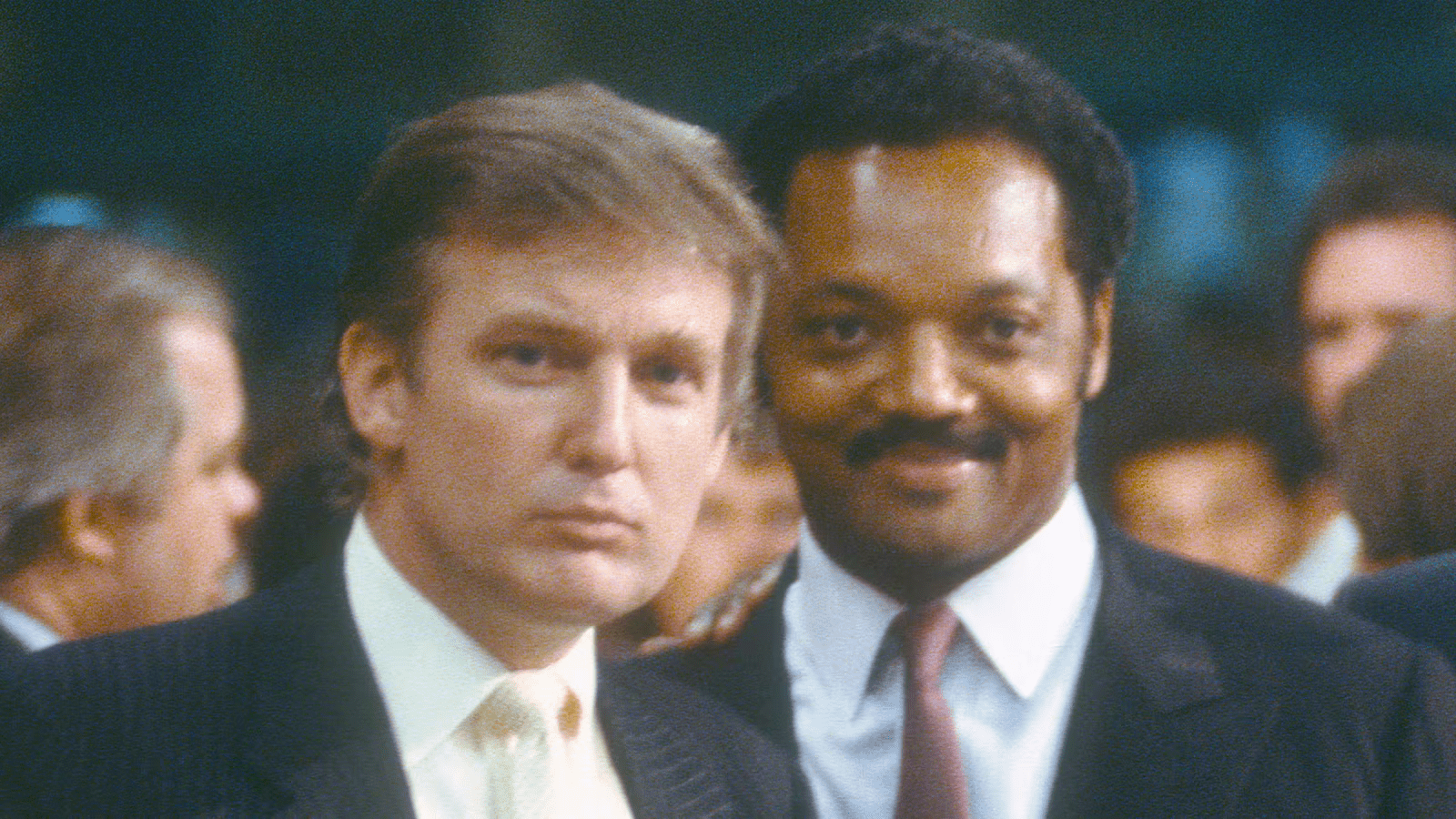
The narrative that Trump directly “funded” Jackson’s 1984 and 1988 presidential campaigns persists in some circles, often amplified by Trump supporters as proof of his longstanding commitment to Black advancement. However, historical records show no credible evidence of such direct financial support from Trump to those campaigns. Jackson’s bids were grassroots efforts fueled by small donations, black business contributions, and progressive networks—not big-money backing from a New York real estate developer. Jackson himself denied any endorsement or financial ties from Trump during that era, calling such claims baseless when resurfaced in later years.What did happen was a series of high-profile collaborations in the late 1990s, when Jackson’s Rainbow/PUSH Coalition was pushing its Wall Street Project to increase minority access to corporate America and financial markets. In 1997, Trump provided free office space at his prestigious 40 Wall Street building to house the initiative—a generous in-kind contribution that gave Jackson’s organization a symbolic foothold in the heart of finance. Jackson didn’t shy away from public gratitude. At a 1998 Rainbow/PUSH event, he introduced Trump warmly as a “friend” whose “social style” masked a “seriousness and commitment to success.” He explicitly thanked Trump for the space, saying it made “a statement about our having a presence” on Wall Street.
The praise peaked in January 1999 at the Wall Street Project conference, where Jackson lauded Trump for “embrac[ing] the underserved communities” and called for his “building skills” and “gusto” to help represent diversity in corporate America. Some accounts even describe Trump receiving a Lifetime Achievement Award or similar recognition from the coalition for his supposed contributions to minorities—gestures that burnished Trump’s image as an inclusive businessman while lending credibility to Jackson’s economic justice efforts. These moments painted a picture of cross-ideological cooperation: a civil rights icon and a capitalist mogul uniting for opportunity.
All of that goodwill evaporated once Trump announced his 2016 presidential run. Jackson, a lifelong Democrat who had backed Clinton, quickly pivoted to sharp condemnation. He described Trump’s campaign as one that “exacerbate[d] fears rather than… expand[ed] hope,” accusing it of seeding division through rhetoric on immigration, race, and nationalism. After Trump’s victory over Clinton, Jackson framed the election as a “struggle for the soul of America,” warning that Trump’s win had unleashed hatred and bigotry. In subsequent years, he repeatedly slammed Trump’s policies and statements as “dangerous, divisive and diversionary,” linking them to white nationalist extremism and attacks on communities of color. Jackson called Trump a man of “inherited wealth and privilege” with “no understanding” of marginalized struggles, and criticized his responses to events like Charlottesville as fueling fear over hope.
The stark contrast is damning. For decades, Jackson accepted Trump’s support when it suited his organization’s needs—free real estate, public platform, and positive optics in elite circles. Yet when Trump challenged the Democratic establishment and won, Jackson discarded that history to align with progressive outrage. This wasn’t evolution based on new evidence; it was selective amnesia driven by party loyalty and the demands of activism in a polarized era. Trump’s pre-political generosity became inconvenient once he represented the opposing side.
In the end, the saga underscores a bitter truth about power in America: alliances are often transactional, and praise flows freely until it no longer serves the agenda. Jackson’s once-effusive words about Trump now stand as an embarrassing relic, a reminder that even icons of moral authority can bend principles when the political winds shift—and that the loudest critics today were sometimes the most enthusiastic admirers yesterday.