

Films are reviewed not simply for contemporary advertising and critical reflection that starts a conversation when they first appear. Many are reconsidered for their social and cultural significance even years after first release. Some films in their art and craft, though relatively neglected initially, may mark historical turning points in the identity and heritage of a people. Yet as an expression of battles for survival, struggles for happiness, and the human prospect they may falsify historical moments and serve to distort understanding of freedom movements past and present.
The merit of a film, or any other artistic expression, is not that they satisfy any narrow political conception, however radical and democratic it may be. Rather, they fill a void in the audience or spectator, who know that society or themselves are damaged or fragmented in some way. Their lives have been shattered or face tremendous burdens. A film, when presented artfully, can suggest the possibility of making humanity whole again or raise questions and start conversations to complete individuals who have become what Gil Scott-Heron called ‘pieces of a man’. Whether the film sprinkles a sensibility about overcoming impediments to us becoming more courageous and intelligent, loving or caring; it is how we think and carry out the final act after the film is over (not the director’s final cut) that is decisive.
Nevertheless, film often speaks of a personal journey with a social background of national or community development that appears to call into question oppressive institutions. Yet if we are not careful, we might be emotionally moved to rally to their repair in defending the search for identity or the singular representative personality depicted. In this way Black people may be presented as heroic or beautiful but not very historical.
Black History is not simply sadistic brutality and degradation; it is the values we place on ourselves, the worldviews and activity we cultivate. Where Black people are victimized (that cannot be denied, for that is what institutional oppression does), this does not mean our activity is cultivating the proper project or goals. Americans, regardless of race, who wish to ‘live the dream’ and see it portrayed don’t like to be told that.

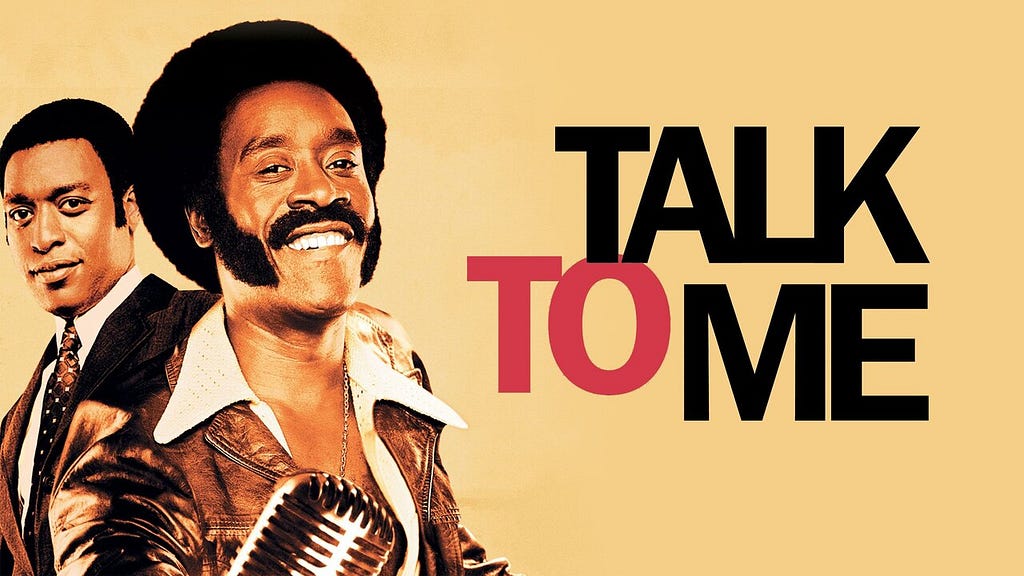
Talk to Me (2008), a biopic of the life of Washington, D. C. radio and television personality Ralph Waldo “Petey” Green (1931–1984), aims to give viewers a look into Green’s life and his rise to prominence as political and social commentator during the late 1960s to the early 1980s. The film is directed by Kasi Lemmons and stars many prominent Hollywood actors such as Don Cheadle, who portrays Green, Chiwetel Ejiofor, Martin Sheen, Taraji P. Henson, and distinguished comedians Cedric the Entertainer and Mike Epps. The movie looks at how Green’s life parallels events during the heights of the Modern Civil Rights (1955–1965) and Black Power Movements (1966–1972) and the role that he played during this period.
The film portrays Green as an outspoken truth teller, and colorful personality that rises from a life of criminality and incarceration to significance in the entertainment world. In 1960, Green is convicted of armed robbery and sentenced to 10 years imprisonment at the Lofton Reformatory in Fairfax County, VA. It is here where Green finds his footing as prison disc jockey and enjoys a measure of celebrity among fellow inmates.
It is also while incarcerated that he meets Dewey Hughes (Ejiofor), a radio personality on WOL, whose brother is incarcerated with Green and introduces the two men during one of the Hughes’ visits with his brother. In 1966, Green is afforded an early release after talking down a fellow inmate, who took to a lofty building in the prison yard, and threatened to jump. Green was summoned to talk the man down due to the social capital he had accumulated by way of his position as prison disc jockey.
In oppressive institutions such as prisons (I know many Americans and African Americans don’t find them oppressive or care how inmates are treated until friends and relatives experience degradation), those being subordinated by such institutions are very rarely afforded the opportunity to have an intimate audience with fellow prisoners, who are perceived popular and powerful. Unless their voice and presence have an anesthetizing, not inciting, effect on their public. While there is really no way to confirm the truth of this, legend has it that Green orchestrated the scene with the suicidal inmate to negotiate a release for good behavior by prison authorities. This scene foreshadowed the role that Green would later play as Trojan horse and mediator on behalf of capital and the state during times of crisis and social upheaval in the late 1960s.
It would be easy for any viewer, socialized and indoctrinated on normative terms, to walk away after viewing Talk to Me thinking that Green spoke truth to and fought against power. As many activists for the state and capital today, Green went behind the curtain and collaborated with power to facilitate his own entrance into the established rules of hierarchy and domination by using his social identity as a Black credible messenger to the dispossessed. Those alert to the precise warnings of the late Imam Jamil Al-Amin (formerly H. Rap Brown) can easily see that while being Black is necessary (one is born with a certain color of skin, perhaps we are aware of our heritage), it is not sufficient when it comes to struggling against forces that look to keep the Black multitudes down. Many confuse the matter that ‘black’ is either an ethic or value system or it can mystify or make ambiguous where people stand. Historically oppressed people cannot be guaranteed to serve liberation struggles, though they may run off their mouth and apparently shout all about this.
In fact, too many protean personalities master their ability to be in lock step culturally and parrot prominent sloganeering to bewilder and discombobulate their audiences. This can make for a captivating film. But it requires closer attention and perception to see what may be wrong with this beyond our immediate titillation and entertainment.
One scene portrays Green as using the kinship he has with activists looking to protest anything perceived as white and therefore bad, to earn a position as a DJ with WOL after initially being viewed as too vulgar and volatile to be placed before the radio station’s morning show audience that was hosted by a long-time DJ that the film portrays as more conservative, easy going, and safe. When turned away for a job, Green returns day-after-day with larger groups of activists protesting the white-owned radio station who already has Hughes, a Black man, amongst important decision makers and as advisor to WOL’s executives and owner, who then agrees to meet with Green after seeing how much influence he has with community members (which serves as a symbol for the potential of increased listenership) and ultimately decides to give Green an opportunity on the station’s morning show slot.
Green is employed with WOL during the aftermath of Rev. Dr. Martin Luther King, Jr.’s assassination in Memphis, TN in 1968. Following King’s assassination, Washington, D.C., like many other cities throughout the United States, exploded into revolt that featured many people taking to the streets to destroy privately owned business and buildings housing public institutions. Although at the time Green was projected as a ‘voice of the people’, WOL called on him to take to their airwaves and chide Black Washingtonians to cease destroying their own communities. This is a recurring role that so-called “responsible” Black leaders are called on to play when the Black multitudes, fed up with constant abuses and degradation by those in power seek to move against the system that degrades them.
We’ve seen this as recent as in the 2020 uprisings in response to the killing of George Floyd. It will be seen again during future uprisings against constant exploitation and barbarity that are part and parcel of capitalism and the state until ordinary people decide to discard these individuals and organizations who seek to appropriate their names, image, and likeness with the intent of reconciling the dispossessed with the dispossessors. Green was a forerunner of “activists” who claim to represent the interest of ordinary Black people as community leaders and spokesman. It is because of figures like Green throughout history that Malcolm X advised his public to be on guard against athletes and entertainers fashioning themselves as community leaders. These individuals are compensated handsomely to misdirect and deceive those who are ignorant of history and who lack political education. The radical Pan Africanist and historian CLR James, who lived in Washington during this urban uprising, taught that when the world is on fire it doesn’t mean our world is on fire. When the government is in crisis, it is not our government. James insisted even if Black people don’t wish to take part in insurgent direct action, proper historical research necessitates discovering the half-hidden local people who took part, clarifying it’s their political thought that matters. Yes, those who moved fast, broke and burned things in response to oppression. But we can only grasp this if we can disentangle Black community control from Black capitalist ambitions.
Green went on to enjoy a prominent and lucrative career in entertainment with his special brand being one who ‘keeps it real’ with an ‘ear to the ground’ to what common people were thinking and feeling at the time. He was given his own television show and at his height, was a guest on the Tonight Show with Johnny Carson which the film depicted as a springboard to superstardom. And this was most often so. Ironically, the film shows Green going onto the Carson show and telling the predominantly white audience that he feels that they are laughing at him and not with him unlike the Black audiences he feels at home with.
This scene seems to suggest that Green refused to “sell out” to the mainstream and remained true to his original audience. The concept of selling out has always been an interesting one when applied to individuals who have already bought into everything the American Dream has to offer. There is no need to sell out when you have already bought in and have no independent values that distinguishes you from the common American dreamers seeking to get their slice of propertied individualism. As aforementioned, Green had already encouraged Black folks to reconcile with the forces who were degrading them every day when he chided them when they engaged in self-directed liberating activity in the aftermath of Dr. King’s death. He had already bought in before he took his “stand” on the Carson show.
In African American folklore there is a common figure known as the signifying monkey. The signifying monkey is a trickster who dupes two powerful figures into clashing toward the monkey’s own end and benefit. As Talk to Me portrays, the signifying monkey does not always use his quick wit, word play, and impishness to counterpose two titans to destroy each other. Imagine if Black freedom movements were so strategic that they found ways for the state and capital to destroy each other and leave us with a greater sense of community control?
As is the case in Talk to Me, Green is the signifying monkey who uses his cunning and guile to mislead those who he claims to provide sound guidance to by exhorting them toward reconciliation with a system that degrades and exploits. It is up to the film’s audience to see this. It is unclear what the director and producer intended. Green maneuvers in a context where the system feigns the ability to reform itself during an impasse with the intent to reconvert, sitting on oppressed people’s backs, once the crisis which brings the prospects of social revolution is averted. Green collaborates to advance his own interest in securing “the bag” while using his social identity as social capital to legitimate his individualistic ends. This is the message that Talk to Me and Petey Green’s rise to prominence as a radio and television personality displays to viewers if they are politically astute enough to take heed.
Rascal figures can be amusing and entertaining, and fictional displays can be satirical where we are compelled to smile and perhaps learn something. Yet artistic representations of true stories with a historical backdrop that remind of Black rebellion and the prospects of revolution must be handled with care and cannot easily be laughed at. When such are transformed into narratives of personal advancement, the street-smart former prisoner who apparently hates whitey turns into a defender of Imperial American Exceptionalism. The magnitude of the conversations this film may have stirred and will stir in the future, is its audience becoming historical actors themselves to complete the struggle of Black community control and discard it as a trope for a hustle that partners with the system it otherwise denounces. A film that starts such conversations may have merit if the characters and plot don’t deliver catharsis (a release from alienation in pursuit of freedom) on their own. Talk to Me’s value may be in starting conversations with marginal sisters and brothers on the street corner who are interested in power and a higher purpose but are not honest about their creative conflicts or inconsistencies in how they condemn systems and institutions. If the producer and director or the writer of the film also have these contradictions, that is neither here nor there. It is our world and self-government that artfully needs to become whole and fulfilled if not completed.
This post was syndicated from Stories by Adofo Minka on Medium
